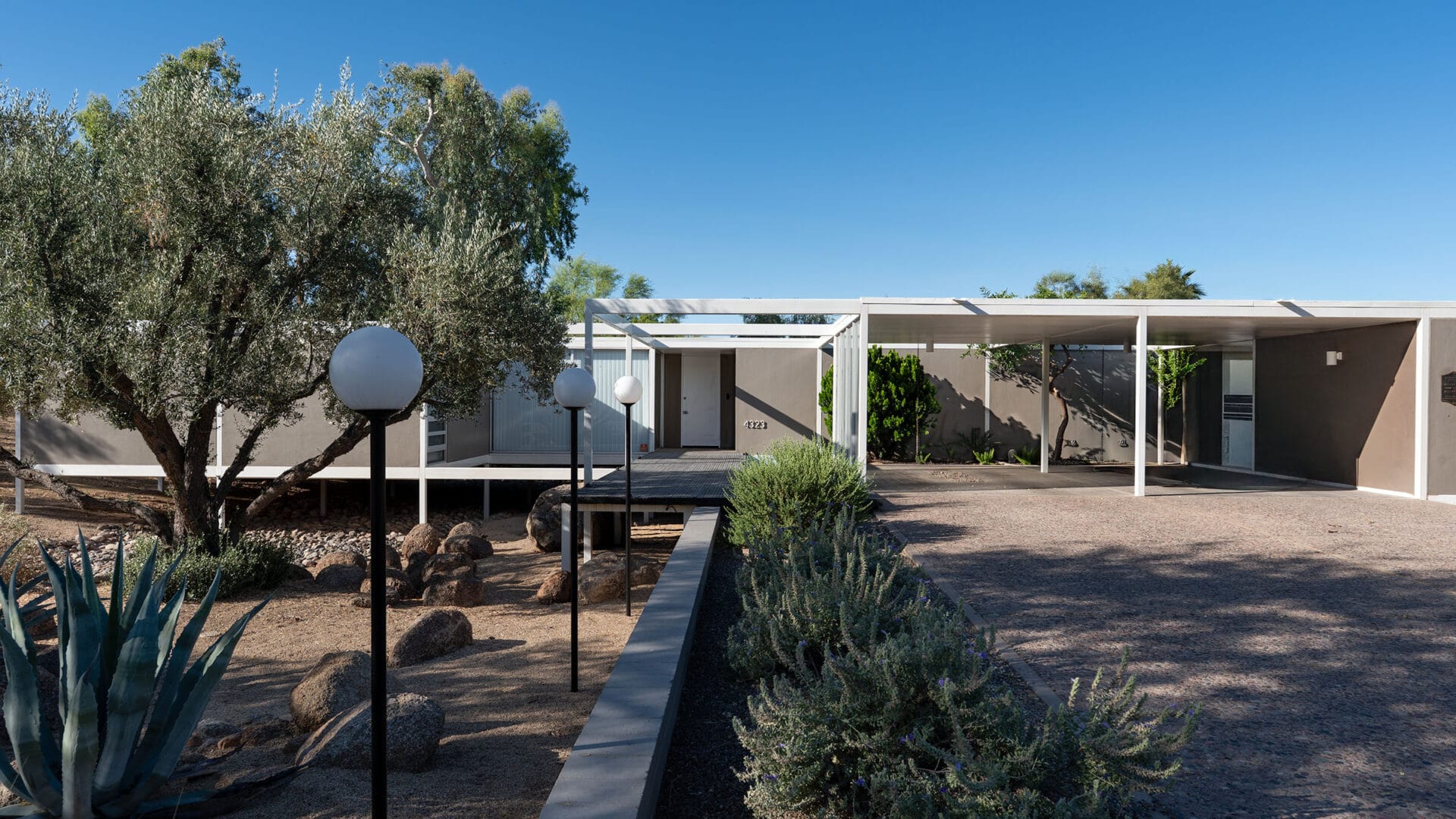
Al Beadle brought discipline to Phoenix modernism.
His work was restrained, rigorous, and unmistakably modern. Where some mid-century architecture leaned into optimism, color, and casual suburban living, Beadle’s work moved in a quieter direction: steel, glass, masonry, flat planes, clean geometry, and a serious commitment to proportion.
His buildings do not try to charm you.
They hold their ground.
A builder’s understanding of architecture
Beadle was born in St. Paul, Minnesota in 1927. After serving in the Navy Construction Battalion during World War II, he returned to Minnesota and worked in construction before relocating to Phoenix in the early 1950s.
That background mattered.
Beadle understood how buildings went together. His work has the clarity of someone who knew structure, material, and construction from the inside. The result was architecture that felt exacting rather than decorative.
He was not interested in excess.
He was interested in form, function, and control.
A different kind of Phoenix modernism
Beadle helped give Phoenix a more austere and architectural version of modernism.
His work often used rectilinear forms, flat roofs, steel framing, glass walls, masonry, open plans, and careful site placement. Many of his homes feel quiet from the street, then open dramatically toward light, view, patio, pool, or desert setting.
That restraint is part of the power.
A Beadle home is not trying to look cute or nostalgic. It is modern in a deeper sense: reduced, deliberate, and built around spatial experience.
Paradise Gardens and the Beadle neighborhood
Paradise Gardens is one of the clearest examples of Beadle’s residential influence in Phoenix.
The neighborhood carries his language at a broader scale: simple forms, deep shade, generous lots, desert planting, block, glass, and a sense of restraint that still feels current. It does not rely on ornament. It relies on proportion and discipline.
That is why Paradise Gardens still stands out.
It feels different from more playful postwar neighborhoods. The mood is calmer, cleaner, and more architectural.
Case Study Apartments and Phoenix recognition
Beadle’s work also reached beyond single-family homes.
His Triad Apartments, also known as Case Study Apartments #1, became part of the larger Case Study program connected to Arts & Architecture magazine. That alone places Beadle inside a broader conversation about modern housing, efficiency, experimentation, and postwar design.
He also designed Executive Towers, one of Phoenix’s most recognizable modern high-rise buildings, along with commercial, hospitality, office, and residential projects throughout the Valley.
His range matters.
Beadle was not just designing houses. He was helping shape the modern image of Phoenix.
What makes Beadle’s work valuable
A Beadle building rewards attention.
The details are often quiet: the way glass meets structure, the way a wall creates privacy, the way a roof plane floats, the way a home is placed on the site, the way the landscape is allowed to remain part of the composition.
His work is not always warm in the conventional sense.
But it has conviction.
That is what separates real architecture from styling.
Why Al Beadle still matters
Phoenix modernism has many voices.
Ralph Haver brought modern design to everyday postwar neighborhoods. Blaine Drake brought a custom, site-sensitive desert modernism shaped by the influence of Frank Lloyd Wright. Bennie Gonzales helped define civic and regional architecture in Scottsdale.
Al Beadle brought restraint.
His work reminds us that good design does not need to be loud. It needs to be clear. It needs proportion, purpose, material honesty, and the confidence to leave things alone.
That lesson still matters.
Especially in a city where too many modern homes are overworked, overstyled, and stripped of architectural discipline.
Beadle’s best work still feels sharp because it was never chasing a trend.
It was architecture.