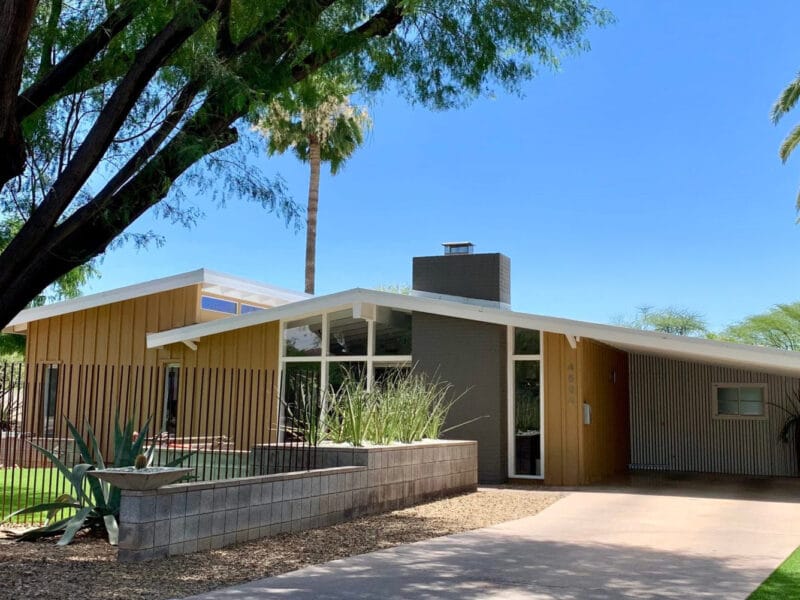
Blaine Drake was one of Phoenix’s most important modernist architects.
His work was not as widely reproduced as Ralph Haver’s or as starkly recognizable as Al Beadle’s, but Drake brought something essential to the Valley: a deeply personal, site-specific version of desert modernism shaped by craft, climate, and the influence of Frank Lloyd Wright.
Drake established his Phoenix practice in 1945 and went on to design a body of work centered largely around custom homes. Many of those homes were built across the Phoenix metro area, each shaped around the client, the lot, and the desert setting.
That is what makes his work so interesting.
From Taliesin to Phoenix
Drake was born in Ogden, Utah in 1911. In the 1930s, he became one of the early apprentices at Taliesin, Frank Lloyd Wright’s architectural school and studio in Wisconsin.
That experience shaped the rest of his career.
Drake absorbed Wright’s belief that architecture should respond to site, material, and the way people live. After leaving Taliesin, he spent time in New Mexico before relocating to Phoenix and opening his own practice.
Unlike many Wright apprentices, Drake built a long independent career. His work carried the influence of Wright, but it was not imitation. It became its own expression of desert living.
A custom approach to modern design
Drake’s architecture stood apart from the growing wave of postwar tract housing.
While much of Phoenix was expanding through repeatable floor plans and efficient subdivisions, Drake focused on custom residential design. His homes were tailored to the client and the site. They often used local materials, natural textures, curved forms, deep shade, and thoughtful orientation.
The result was modern architecture with warmth and individuality.
Drake’s homes do not all look the same. That is part of the appeal. His work was less about a signature gimmick and more about an approach: listen to the site, use honest materials, control the light, and design for the desert.
Phoenix work and lasting influence
Drake designed a cluster of homes in Bartlett Estates near the Biltmore area, including his early Phoenix work in the late 1940s. These homes helped bring attention to custom modern living in Phoenix at a time when the city was beginning to define its postwar architectural identity.
His work also extended beyond single-family homes. Drake designed apartment buildings, offices, medical buildings, churches, and other projects. Among his better-known works are the Unitarian Universalist Church on Lincoln Drive, a remodel of the Heard Museum, and work at the Camelback Inn.
Some of his residential projects have been lost, including the Scoville House, demolished in 2008. That loss is a reminder of how fragile Phoenix’s modernist legacy can be.
What makes a Drake home special
Blaine Drake homes are rare, and they require a trained eye.
They often reveal themselves through material choices, proportion, desert siting, rooflines, masonry, curved forms, window placement, and a strong relationship between interior and exterior space. His homes tend to feel more custom, more individual, and more tied to the land than many postwar designs.
They are not always obvious at first glance.
That is part of their value.
A Drake home rewards attention. The architecture is thoughtful, quiet, and often deeply connected to its setting.
Why Drake still matters
Phoenix modernism was never one thing.
It included tract homes, custom estates, desert compounds, experimental apartments, churches, schools, and commercial buildings. Blaine Drake represents an important part of that story: the custom modern home designed with care, climate, and individuality in mind.
His work helps explain why Phoenix has more architectural depth than many people realize.
For buyers, sellers, and homeowners, understanding Drake’s work is about more than recognizing a name. It is about recognizing the value of design that responds to place.
That kind of architecture is rare.
And it is worth protecting.